Anna Turney opened proceedings telling us of her journey; a Paralympic Alpine Ski Racer, Anna Turney, finished 6th in the Vancouver Paralympics only 4 years after becoming paralysed whilst snowboard racing. Nick Fuller, Head of Education, LOCOG, then went on to speak about the values of the Olympics and how we can bring them into our classrooms in the runup to the London 2012 Olympics. has free resources, including opportunities for blogging, cross-curricular language use re cooking, communication, enterprise etc, information about competing teams and the pre-games training camps available. As a department, we had already decided to include a unit on the Olympics and this gives us the impetus to gather ideas and resources, as well as Jo Rhys-Jones' brilliant site
Tsk, tsk, I have just noticed that it has been too long since I last blogged here, though I did start up a Posterous blog for our school trip to Spain However, excuses over, many blogposts coming up soon, including a flurry to match the lovely Lisa's There is nothing like a language conference for that rush of blood to your head, with all the inspirational talks, and the ultimate feel-good factor of meeting the MFL Twitterati again for blogging again.
After hearing Chris Harte talking about Solo taxonomy at ILILC in Southampton earlier this year, , I have been trying to get pupils to think more about language, its formation and the patterns they can see.
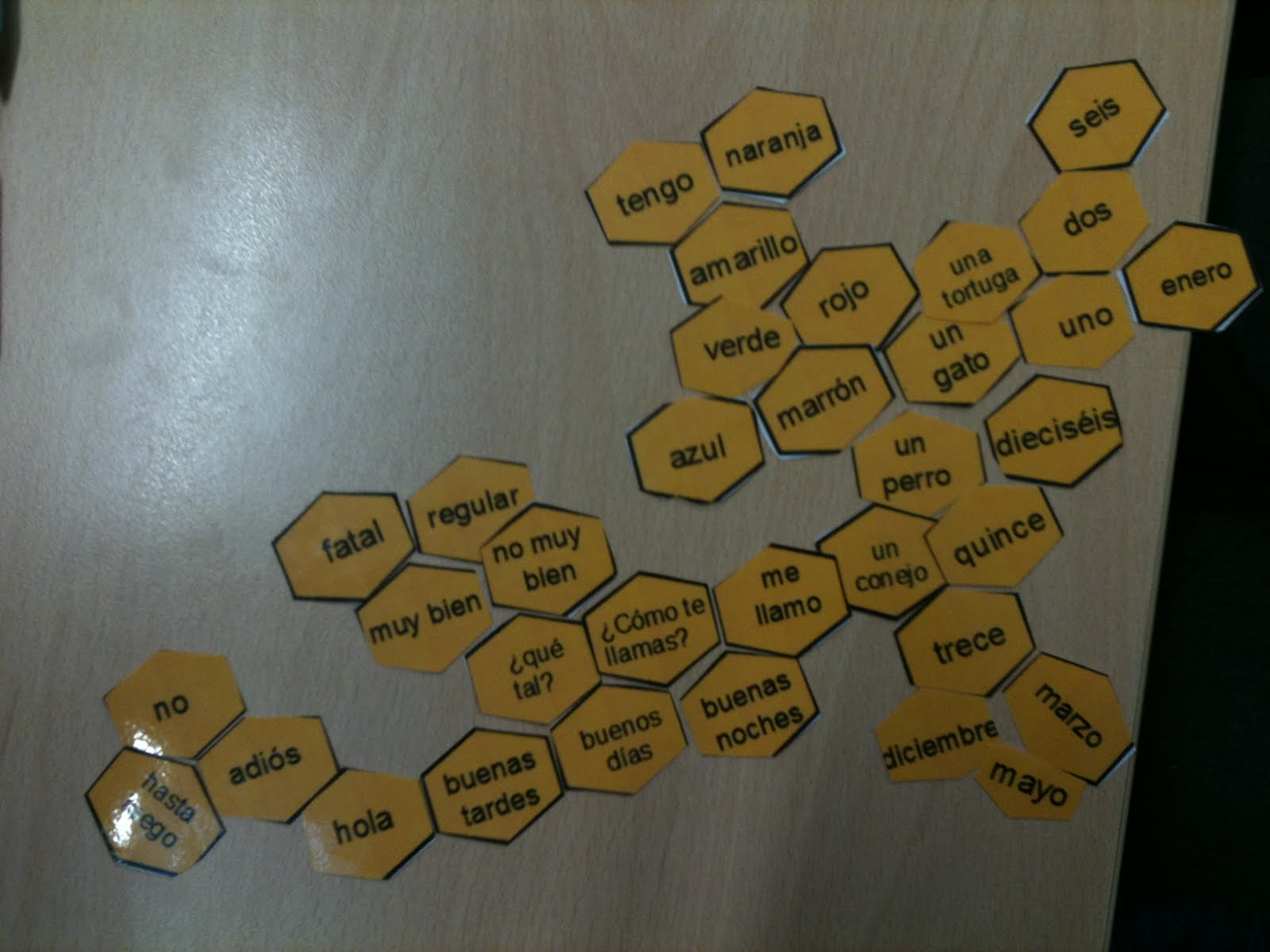
Having already done a similar exercise with Lower 6 a while ago, I decided to experiment today with my two Primary 6 classes in the local primary school. They have been doing half an hour Spanish a week with me since Christmas.
I divided the class into pairs or groups of 3, and distributed the sheets to the pupils. After a frenzied 5 minutes of cutting, the pupils were ready to go. I told them I wanted them to group the hexagons into honeycombs by putting linking words together. The bigger the honeycomb, the more links they would have found.
It was particularly interesting to see the difference in the two classes, in terms of those who found most links. The pupils chose their groups and the majority were same sex. In one class, two groups of girls 'got it' best whilst in the second class, it was two groups of boys. Perhaps obviously, it was those who generally contribute most verbally in Spanish class who made the most links, but oleasingly the activity drew in others who have not been so vocal or engaged.
It was fascinating to see pupils with a fairly limited amount of Spanish talk through reasons for their groupings, and see connections in language. It has enthused me to start using this activity more with my own pupils.
Today our Head of Department turned the tables on us, delivering a 10 minute slot in Japanese entirely in the target language. The lesson included a handout, IWB and miniwhiteboards, with whole class and group work included.
It proved to be a bit of a double-edged sword. On one hand, he was happy to point out that we had coped with some fairly in-depth grammar including tenses, althouhg of course we are all linguists. Yet the discussion after the 'lesson' raised some interesting points about what it must be like to be a pupil in the language classroom, especially when we use target language.
I have no Japanese, and found the whole-class intro stressful, particularly when some others appeared to know a lot or 'get it' quicker than me. I was far happier and indeed quite enjoyed the challenge when presented with key vocab and a sentence to translate.
The reaction from the department was mixed in terms of how we felt as pupils, with some really enjoying it (including those who had a little previous experience of Japanese) and others sharing my feelings of stress. We all agreed that having some knowledge of pronunciation and basic vocabulary would have aided our comprehension and learnig.
Would I like to be a pupil in my classroom? I'm not sure, actually. I think I may be one of those who prefers to take things at their own pace, and process systems and patterns for myself. But at the very least, today's experiment has reminded me of the range of emotions felt by my pupils, and to tailor my teaching accordingly.
The end of term also saw the advent of what has now become an annual A level Spanish Immersion 'Weekend' albeit not always at the weekend. This year, 21 Grosvenor pupils, along with 3 teachers, our assistants Vicent and Cristina, our student and a past pupil all spent 2 idyllic days at the residential centre in the Ulster Folk and Transport Museum in Cultra, Holywood.
Activities included a series of workshops focusing on listening, reading and speaking, as well as activities such as Dragon's Den, a treasure hunt, a quiz, DVDs and songs. The Dragon's Den activity this year was by far the best yet, with very imaginative ideas from all groups.
Some new activities included a group discussion of survival items after their boat sinking in the ocean, as well as a quiz where pupils had to pair up the teachers with the unknown facts which included a diverse range of topics from an all-Ireland rower to two false teeeth!
Pupils embraced the Spanish as never before, and all staff were delighted by efforts and enthusiasm. To give up 2 days' holiday as staff was part of the job, but for pupils to do the same was a big ask, yet those who came were a joy to work with and left us all energised for what remains of the academic year as well as being a good preparation for the pupils for the looming oral examination.
On his blog Box of Tricks José Picardo assured us that "Popplet is a fun and intuitive web application that allows you and your students to create galleries, mind maps and diagrams quickly an incredibly easily. I mean it. Ridiculously easily." So I thought I would put it to the test..
Signing up was extremely straightforward, with immediate access to the account and the chance to launch straight in. Today I used Popplet with Form 4 (14-15 yr olds) as a whole class activity to change holiday activities from the infinitive into the preterite tense, in advance of their Controlled Assessment.
With Form 5, I put 3 bubbles, or Popples, onto the IWB and they worked in groups to prepare vocabulary for each one, before coming together as a class to build a set of vocabulary on Media.
Popplet is very intuitive in its functions, and appealed greatly to the pupils as a revision aid for independent study, as well as a useful class tool for collating ideas and vocabulary.
Sometimes I am guilty of feeling that if a lesson hasn't taken me a long time to prepare and doesn't involve some sort of ICT, then it couldn't possibly be a good lesson. Today I wanted to revise some basic vocabulary in our local primary before moving on to a new topic, so I grabbed my bomb and Rhoda as I dashed out the door. GGS pupils will be familiar with both, but this was the first time that I had used either with the primary pupils. We moved the desks to the side of the room and put our chairs in a circle. I used the bomb (from the Pass the Bomb game) to revise the numbers 1-20 as a starter. If the bomb 'exploded' they had to tell us something about themselves in Spanish. Normally at GGS it is a harsher penalty, either asking someone on a date or mooing like a cow in a neighbouring class, but P6 aren't that used to me and I feared tears!
Pupils then moved to the floor when I brought out Rhoda, my sheet with different coloured squares. Each pupil had a marker and knew which square to aim for depending on the word I said eg. numbers were pink, etc.. The golden rule was that they weren't allowed to change their mind and move their marker. We started with 3 max per square and then cut it down as more pupils were put out. As pupils were disqualified, they then became my judges.
Pupils veered between terrified and thrilled in Pass the Bomb, and they all adored Rhoda. This was a lesson with no preparation and was low tech, yet all were engaged and learning tok place. Do the sums...