Showing posts with label Rachel Hawkes. Show all posts

Monday, 27 February 2012

#ILILC2 LANGUAGES AND THE OLYMPICS

Here is my presentation on how we will incorporate the Olympics into our teaching at KS3. I am heavily indebted to Rachel Hawkes, Neil Jones and Greg Horton amongst others, who kindly gave permission for me to adapt resources they have made

Wednesday, 26 October 2011

Feeling gratitude and not expressing it is like wrapping a present and not giving it. ~William A. Ward

The title of this blogpost is a small nod of recognition once again to the wonderfully generous spirit that is Rachel Hawkes Today Form 4 and I had a brilliant lesson and the resources were all directly adapted from Rachel's many powerpoints available on her website.

We started with the "What's the question?" slide, after going through all the Spanish question words. This is an area which I think we often neglect as language teachers, focusing instead on the answers. It makes sense to ensure that pupils not only are familiar with question words but are comfortable using them.

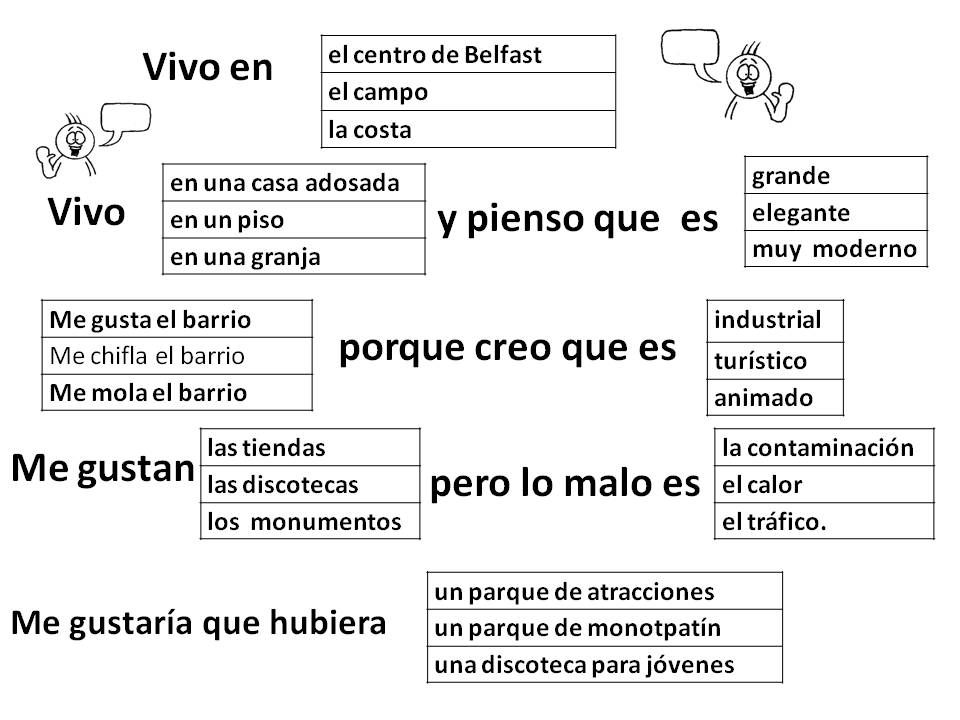
This game is so simple yet brilliant for learning vocabulary. Pupils work in pairs, each with a sheet. They choose their options secretly then take it in turns to try to guess the options their partner has chosen. If they guess right, they continue. IF they get it wrong, play passes to their partner, and they must start at the beginning again.

As suggested by Rachel, pupils used post-its to write down as much vocabulary as possible on the chosen topic for 2 minutes and then swapped with a partner to see if they could add any in a different colour. They then had 1 minute to memorise as many words as possible from their list before sticking the post-it to the back of their chair and taking 1 minute to write down as much vocabulary as possible. This was a brilliant way of showing pupils how much they knew as well as working on developing memory skills.

We used this slide to ask questions in advance of viewing the next slide with the photo, again useful if only to get pupils comfortable asking questions in Spanish.

We finished with this slide, where pupils again worked in pairs, one speaking and the other listening. This activity is called 'Spend the words' with the idea that the speaker is focused on raising the level of Spanish spoken, as pupils hand over the words/phrases as they use them, ideally ending with none left.
This was a brilliant lesson, with lots of spontaneous Spanish being spoken, and a real buzz of enthusiasm for the tasks. And the best thing is, there's plenty left...

Friday, 30 September 2011

#MFLSAT EMMA BAINS @bains_1 SMALL CHANGES TO CURRICULUM TO IMPROVE MOTIVATION

Despite the title of her talk, Emma has made more than a few small changes to overthrow the curriculum in order to do interesting stuff. We were blown away by the variety of topics that her pupils cover in KS3, and the novel approach she has taken to some of the more traditional topics.
• Sat Nav navigation using PPT and Audacity to navigate from their house to school, rather than straightforward learning of directionshttp://www.blogger.com/img/blank.gif
• Feedback sheet with sentence starters to help pupils articulate what they have learnt
• Cognates text (quite long)then extended writing
• Cluedo game whereby pupils keep guessing who committed the crime, with what and where, until they have the whole sentence correct
• UNICEF video derecho/reponsabilidad sentences
• What am I? Pupils create a series of sentences eg I have a long tail etc for others to guess who or what they are
• Questions before listening activity
Despite Emma’s protestations of extreme nervousness, this was a superb presentation which ties in closely to Rachel Hawkes’ ideas on teaching at KS3, and which we are trying to adopt ourselves in Grosvenor.

Monday, 11 July 2011

#LW2011 Greg Horton Active learning and Raising achievement

This was a more active session than I had anticipated, yet I should have guessed from the title, and from what I had heard about Greg in advance. We started with PE warm ups, with instructions in the target language. Greg suggested that pupils adapt their own model and lead future warm-up sessions. He also said that he uses this at any time to re-engage pupils in a lesson eg he walks round the room and will randomly shout an instruction to anyone not paying attention.

Kagan Timed Pair Share
Greg had a slide with pictures of different coloured eyes and the Spanish beside it: Tienes los ojos.. with colours. Put the music on, pupils circulate, having agreed in advance who talks first when the music stops eg the person with the biggest right hand, highest playing card, tallest person. Another option is to either do word lists when the music stops or person B gives feedback in TL to what person A says eg A gives personal details, B repeats it back to them in the 'you' form.

Greg's approach is making a physical response a routine part of the learning in his classroom. In this sense, it ties in closely with Rachel Hawkes' approach to teaching phonics, subject pronouns and verbs. Greg talked about levels of active learning:
o Word level (fun but..)
o Sentence level (manipulation and creativity)
o Conceptual (tense and grammar)

He teaches connectives with gestures in Form 1/Year 7, early on. Anytime anyone uses one, the whole class has to do the action. If you teach with gestures then read a text, they should do the actions.

Human word chains
These are particularly effective for a starter or a plenary. Give teams pieces of paper, so that each pupil has one word. Pupils can repeat their word but not show it, and the teams have to organise themselves into a sentence which makes sense. This activity reinforces basic sentence structure. If you wish to repeat the activity in the next lesson, make pupils guardians of their word, so that they need to remember their word and where they were in the line. At a higher level, the tecaher can add detail such as "I’d like the two adjectives to sit down” Then you can have runners run down the back of the line and shout the missing word(s) out in the appropriate gap in the sentence as the remaining 'sentence' pupils shout out their word in order. To take this to a higher lecel, construct, deconstruct, adapt and extend – invite the rest of the class to be extra words or punctuation. Kids can also choose the words they want to be.
Add gestures to this activity to make it more active; eg someone acting a connective or sequencing word does windmill action. The last person needs to be punctuation, eg the full stop sits on the floor, whilst the first person stands on a chair to illustrate that they are a capital letter.

PRONOUNS
Greg teaches his pupils Subject pronouns gestures, eg ointing to himself with one hand for I, pointing with two hands in front for You plural. To add to this, he suggests you use these with We Will Rock You music, where the teacher says the word on one beat and the pupils then do the gestures. Once pupils have got this, you can mime the pronoun and the verb, adding past or future once advanced, and pupils shout out the answer.

The clock times ballet
This is done to classical music, where Greg says the time, then pupils use their arms to represent the time on the second beat. This proved quite hilarious for our group, some of whom lacked the coordination to become a prima ballerina.

All in all, this was a really really useful session in terms of practical, immediate methodology which you could do at any time with little or no preparation, but which I think will prove to have a maasive impact on learning in the classroom.

Sunday, 10 July 2011

#LW2011 GIVING LANGUAGES THE X FACTOR

This session was led by Rachel Hawkes, Jane Driver and Sarah Schechter and gave me so many ideas, my head was buzzing.
Routes into Languages promotes universities working with schools to enthuse and encourage young people to study languages from KS3 onwards.Sarah talked about the Supporter to reporter scheme, where the university has trained up journalists for the Olympics in the 3 languages. This made me think about doing something similar but on a much smaller scale, with our own Media Studies department.

We also learnt about Student language ambassadors and Language Leader awards within Rachel and Jane's school, Comberton Village College. Pupils learn how to teach primary pupils over the course of the academic year, although you could do it with younger pupils within your own school. This is something that we are definitely going to look at within our department in Septemberm most likely with Fifth Years and Sixth Years. As Rachel pointed out, the scheme is practical, it rewards language learning, it develops general communication and leadership skills and it teaches pupils empathy, self-esteem and confidence. The pupils practise their skills in peer groups in weekly lessons, develop lessons, create resources, trialling them with peers then they teach finally. At CVC, there are 3 visits – Autumn, Spring, Summer. Pupils plan in pairs or trios for a 1 hour lesson in the primary school, divided into 3 x 20mins, each pupil teaching their own 20 minute slot.
The following are the practicalities:
o Launch assembly
o Parent letter
o Completion/submission of application form
o Selection for September
o Carousel activity for younger LLs
o http://rilanguageleaderaward.wikispaces.com

Foreign Language Spelling Beeo www.flspellingbee.co.uk
Jane talked us through the phenomenon that is the Foreign Language Spelling Bee, with the following as the basics:
o 1 minute competition
o Stage 1- Class competition
o Stage 2- School competition
o Stage 3 Regional competition
o Stage 4 National competition

The benefits of the the spelling bee are in terms of memory, phonics, pronunciation, alphabet and awareness of articles. In terms of the actual format on the day, the pupil stands with their back to the board, where the words are displayed. The teacher says the word in English, the pupil says it in the TL and then spells it in the TL alphabet. They spell as many possible in 1 minute. CVC's ML department runs it weekly with language student leaders (Year 9 pupils). They run training sessions, help organise the event and produce and manage the website.

Language on Film/Language from Film
This film-making project is another extra-curricular activity that the staff run for pupils at CVC. Expertise is brought in from the university with a group of teachers being trained up. Pupils need to approach this task exactly as the professionals would:
o Proposal and pitch
o Pre-production
o Production
o Post production
o Exhibition
In terms of other schools adapting this, it was suggested that it could take many different formats, eg collapsed curriculum, exchange day (in one language with subtitles in other language, making it periods 1-4 then watch them after lunch), with a lower ability group. I wonder if we could tie in to the Belfast Film Festival, maybe ask the A level Media Studies pupils to mentor re the technical side. Sarah has a DVD to show how to do it all and was happy to share with all.

This was one of the most inspiring yet most exhausting sessions I attended over the course of the two days. There were so many ideas here, yet it would be difficult to run them on a large scale without the support of an organisation such as Routes into Languages. I already knew how hard-working Rachel was, but to spend time in the company of these three ladies, as I had the opportunity to do on Friday, was to be awed, inspired and a little bit overcome. I asked Jane when she ate lunch, and she laughed..

I am unsure what we will take on board, I so want to do it all, yet bear in mind that my head was already buzzing from Rachel's previous talks and how we want to change our schemes of work. And there are other changes I want to make too, from other inspirational speakers. I'll keep you posted...

Saturday, 9 July 2011

#LW2011 CPD: teachers working collaboratively

The first talk I went to was by Rachel Hawkes who recently came to Belfast to deliver a highly successful training day in conjunction with NICILT. Rachel covers so much ground in her talks that it was good to hear her again so soon after the last talk and process her many great ideas again.
Through LinkedUp , Northgate High School (Vincent Everett) and Comberton Village College trialled a scheme of mixed age language learning. Amongst the many advantages, Rachel commented that adults ask higher order questions, have high literacy levels, spot links and gently prompt younger learners to the right answer.Their pronunciation is better in that they try harder. By their presence, adults send a powerful message about language learning as they are giving up their own time. In terms of ICT they are behind the pupils, generally, but they generated competition and gave excellent feedback re clarity of teaching. Given their appetite for learning, Rachel and the CVC staff observed more learning outside the classroom.

Spontaneous Talk
This is where speaking in the language classroom is unplanned, where there is no script, where the questions and answers are unknown. Whilst as teachers we may worry about scaring the pupils, the CVC pupils commented that it‘shows what we really know’, and that they can talk ‘off the top of our heads’ There are many ways to promote Spontaneous Talk, according to Rachel, including:
o question routines
o 20 questions (Have you..? Do you like..? How..? Where..? Is..?)
o What are the questions? (give pupils a ppt with a series of answers, and they suggest the questions)
o Find someone who (great for practising the familiar 'you' form)
o using Piensas que…? for any statement, where their partner has to answer
o Elaborating
o Say something else
o Pimp my language! (eg Juego al tenis – what can you do to soup it up?)
o Have I got news for you (blankfill) NB Personalising it makes it work better
o CLIL
Pure or impure (impure CLIL = still has the focus on the linguistic aim, language, but using new and interesting topics)
o Focus on ‘new knowledge’
o Authentic materials
o Challenging texts
o High use of TL

There are a vast quantity of resources available on Rachel's website, including her CLIL water module in Spanish, with resources from the Western Sahara. She suggests using BBC Clips which has loads of clips on different themes which you can use to make T/F and gapfills.

As always, this was an inspiring journey through ideas and resources which are immediately available to use in the language classroom. Since Rachel's talk in Belfast, we have already overhauled our KS3 Scheme of Work, but looking at her website would encourage me to go even further.