Showing posts with label Twitter. Show all posts

Friday, 1 April 2016

Everyone is a genius.... A little bit of differentiation


This year as a staff we are looking at differentiation, what we currently do and sharing good practice on staff days and in departmental meetings. I personally would say that I struggle with the challenges of differentiation in the traditional terms of multiple worksheets to choose from, etc.  However I am enjoying the different ideas we are coming up with and seeing how pupils respond to them.

A fairly recent arrival to the Spanish Department is our Challenge Grid. I first spotted a tweet by Jake Hunton https://twitter.com/jakehuntonMFL and Jake kindly emailed me his template to use and adapt. The basic premise is that pupils should see how many points they can accumulate in 15 mins. This is one for our Form 1 pupils on the topic of physical description (obviously when it is displayed as a powerpoint, there won't be underlining)


Another option is to give them a worksheet with sentences with different points values and tell them they need to score a certain number of points, as demonstrated here by my colleague's worksheet.
                     

A third idea we are trialling around choices is an Extension PPT. My colleague has made this first one and I have then made another for the Form 3 topic of clothes.


Another staff focus this year is marking for improvement. And surely there is no greater differentiation than tailoring the learning to suit the individual pupil. As part of this, I am looking at feedback inc highlighting the correct work in A level essays rather than showing what's wrong and witholding their score until they have had DIRT time. The pupils have really liked the positive highlighted marking and they are now learning to apply the mark scheme better as they look at what they have done well and write their own www and ebi


I am building DIRT time into lessons at all levels, including using our purple pens for self-reflection. It is enlightening and rewarding, for the pupils and for me.

Another marking and feedback idea I am excited to try out is LIFT, one of many ideas I have magpied from the great Gianfranco Conti https://gianfrancoconti.wordpress.com/2016/02/21/six-things-i-tried-out-this-year-which-really-enhanced-my-teaching/
"LIFT, or Learner Initiated Feedback Technique .... consists of questions about linguistic items they are using in their written pieces that they annotate in the margin of the page they are writing on. For example, if they are not sure whether a clause requires  the subjunctive or  conditional mood, they will underline or circle the verb and write on margin: “Is this verb supposed to be in the subjunctive? Why/Why not? This year, I have used it more consistently, extensively and, more importantly I have insisted on higher quality questions. It has made me enjoy giving feedback more and my students have reported benefitting from it"
Further reading I've really enjoyed on marking and differentiation can be found at https://gianfrancoconti.wordpress.com/2015/05/12/five-things-you-should-do-when-you-correct-your-students-essays/ as well as  http://justtryingtobebetter.net/marking-is-feedback-is-differentiation-is-planning/

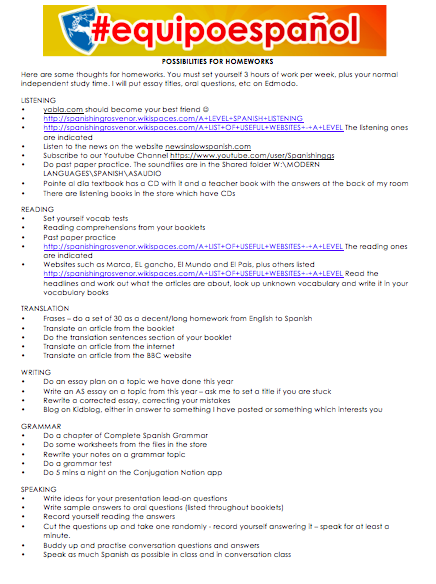
As well as these newer ideas, there are strategies that I have been using for months or years that are also individualising the learning and hopefully therefore differentiating. By creating iBooks at A level and some at GCSE, I am allowing pupils to work at own speed and choose their activities. The drawback from the pupil perspective is that some pupils may not be good at timing and pacing themselves and I have found that some don't cope so well and need more of a guiding hand to stay on task. The same has happened with setting their own HWs at A level. It has been excellent for many pupils but I need a better system for checking what pupils have done and some don't want to choose their own homeworks or don't do it and try to get away with it. At the moment they have a choice of a Learning Log or a simple tick grid.
                   

We also have Challenge Corner with Challenge Cards,  Jenga with accompanying Spanish sheets, Spanish novels, translations of books like Diary of a Wimpy Kid and Harry Potter, magazines and comic books. This year I've also brought in the idea of Cushion Corner, so that pupils who finish first aren't 'penalised' by being given another worksheet but can choose what they would like to do from any of the above to extend their learning.

An idea that is bandied about a lot now on Twitter is Takeaway Homework or giving pupils a choice when it comes to CATs and that's something that we would like to look at as a department. For me the difficulty is balancing the choice for the pupils (which I love) with the need for CAT scores for report cards, so we'll need to look at that.

Finally if you haven't seen it, check out https://www.tes.com/teaching-resource/the-differentiation-deviser-6233159, 81 slides of differentiating ideas for the classroom.


Friday, 26 September 2014

Reflections of an iPad classroom 26/9/14

Oh blog, it's been a while. Apologies but I'm sure I'm just like the rest of you, hitting the ground running after the summer. 

So the iPads are still with me for the foreseeable future and the HODs and SMT in school have all got one each too. It's been weird for me trying to think about how to use one iPad in a classroom when I'm used to at least one between two, one each at A level. There are certain apps which lend themselves to it of course, from the fabulous Explain Everything to my two of my favourites for starters,  Decide Now and Make Dice Lite. 

I have been using Explain Everything in three main ways. Firstly, I have made some videos, using old PPTs and recording audio with them, as a way to flip the classroom. The videos are uploaded to Edmodo and the pupils can access them there in advance of the lesson, which frees up the lesson time to consolidate learning. Secondly, I have marked pupil work which they uploaded to Edmodo, talking through mistakes as I circled them using the pen tool and then I uploaded the video back onto Edmodo for them to watch and correct their work. Lastly, I have taken pictures of pupils' work in class as we have worked through translation work. It is easier for them to see corrections if they can see the base model on the screen and we talk through the different options they have too. I am finding that they are contributing more than they would otherwise. 

With the set of 17 iPads, we have been using Quizlet in bursts within the lesson to consolidate vocabulary acquisition. The pupils love it and feel it has really helped them learn the vocab. I set up a departmental account that they all log in to, which means that the tailored vocabulary is there waiting for them. Interestingly, we find the website better than the app, if you choose to use it. 

Finally, today I used Plickers for the first time. I had read about it on Twitter but hadn't done anything with it yet. It's a way of using one iPad in the classroom to assess pupil understanding and record answers. I'll do a separate blogpost on it soon. 

Tuesday, 11 February 2014

The meaning of Twitter for my PGCE talk

I tweeted tonight to ask people what Twitter meant to them in advance of my MFL PGCE talk tomorrow. Here's a Wordle of the responses.

Sunday, 14 October 2012

GRACIAS A TWITTER

Tomorrow I am revising names and ages with Form 1 and describing bedrooms with Form 2. Inspired by the amazing blog http://creativelanguageclass.wordpress.com/ I tweeted two questions earlier this evening. As always, the amazing #mfltwitterati came to my rescue

I am going to use the personal details to prompt oral work with Form 1. With Form 2, I am going to do an old favourite: 4 mins to read on own, highlighting everything they know, 3 mins with a partner to discuss unknown vocabulary, 4 mins in groups at their desks then we will all come together. I will read and they shout 'para' when I come to a word they still don't know. This has worked well in the past and they love the fact that it is 'real people' who have tweeted for their Spanish class :-)


Wednesday, 29 February 2012

#ILILC2


So my second visit to Southampton for the ICT Links in Languages was much anticipated and did not fail to impress. There was much excitement amongst the attending members of the #MFLTwitterati on Twitter in the weeks leading up to the conference, both from those of us lucky enough to have attended last year, and those who were coming for the first time.
There was a gathering of the clans on the Friday night, with the unveiling of the wonder that is Suzi Bewell's #mfltwitterati t-shirts.

This set the tone for the whole weekend. The workshops and talks were excellent, led by Joe Dale and José Picardo's fab keynotes, and the chance to network, meet new enthusaistic language teachers and chat was superb. I am going to blog about the brilliant workshops and talks I attended over the next week or so, but suffice to say there was plenty of expertise, stimulation and humour on show.
The highlight for many was the Show and Tell on the Saturday night, with just the right level in terms of weightiness of topics combined with singing, dancing and general euphoria. It is enough to mention human dominoes, Tchik et Tchak, turnips and barmen to provoke sniggers and laughs from all who were there.
In these days of pressure and stress, #ILILC2 was a much needed tonic and a wonderful opportunity to catch up with many of my PLN whom I now consider true friends.

Monday, 11 July 2011

#LW2011 concluding remarks

So that's it, all the sessions I attended blogged about. I feel at a bit of a loss now - oh no, that's right, I now need to decide what to incorporate into our schemes of work, where and who with, which projects and activities should be piloted this coming academic year and which I should push to the 'slightly ambitious at the mo, so let's think about it for a while' pile. The problem is that I'm an 'everything now' kinda gal...

There has been quite a lot of chat on Twitter and the MFL Resources forum about the conference, both from delegates and those who couldn't make it. Whilst I hope that my tweets and blogposts help those who couldn't make those sessions, or couldn't come fullstop, it definitely won't be the same. The dinner was great craic, and the social gathering afterwards a personal highlight for me.

In the same way as we all felt after the #ililc conference in Southampton earlier this year, there is a definite buzz about attending these events, a joy in meeting people off the forum and especially the MFL Twitterati peeps who have become true friends over the past months and years. We revelled in meeting up again, and I felt emotionally overwrought at leaving them all again late Saturday afternoon. As I said on MFL Resources, at the risk of sounding cheesy, they gladden my heart.

I hope I don't leave anyone out, but here is a shoutout to those true friends I saw again or met for the first time - follow them on Twitter if you don't already:
@lisibo @charte @ChrisFullerisms @blagona @wizenedcrone @icpjones @joedale @mrshampson @thwartedmum @sylviaduckworth @RachelHawkes60 @zenahilton @Chapeluser @HelenMyers and to new friends @IssacGreaves @StuartThomas3(and the Oscar dude, when he gets on Twitter!)

Thursday, 30 September 2010

PLAYING HOST TO THE 8th MFL FLASHMEETING

Monday past saw the 8th MFL flashmeeting. These flashmeetings are a form of online conference where a group of like-minded MFL teachers from the UK and beyond gather together virtually to discuss the latest in teaching and learning within the field of Modern Languages. Many of us 'know' each other through Twitter, and it is a pleasure for the MFL Twitterati to join togther regularlyand with enthusiasm to talk through issues and ideas, as well as to share best practice. This time, it was my dubious honour to chair the meeting, and it was with an unfamiliar nervousness that I signed in, yet once proceedings were up and running, I actually thoroughly enjoyed it. Catch the FM here:
http://flashmeeting.e2bn.net/fm/fmm.php?pwd=ad0103-10733

Thursday, 1 October 2009

FLASHMEETING #3 AND ITS CONSEQUENCES

Well, we had our third MFL flashmeeting last Monday and whilst I participated less, with a blinder of a headache, it was still a stimulating and enjoyable experience, as well as being extremely benficial for my teaching.

Flashmeetings serve to remind me how much I have come to rely on the support of my online friends whom I have met through Twitter primarily, as well as at Joe Dale's IOW conference. They are a constant source of support and inspiration, and this flashmeeting was no exception.

The two areas I have decided to focus on, arising out of the meeting, are Spanish phonics and Edmodo. I still have a lot of work to do in terms of phonics and pronunciation, but José Picardo has inspired me to set up an account on Edmodo (www.edmodo.com) I have created course areas for each of my classes and have already posted some polls in Spanish and set some assignments.

When I was showing the setup page to the pupils, many commented on its similarity to Facebook, and the trendy look of the site. Several have already posted comments and queries on their course area.

I look forward to using Edmodo and will post soon on the progress we are making.

Wednesday, 24 June 2009

Guest posting and my year of web 2.0

I was genuinely flattered to be asked by Ken Royal to be a guest author for his blog http://www.educatorsroyaltreatment.com, although I asked him what he felt I had to offer as I really feel like a complete novice at this whole malarkey! It is true that I have a great enthusiasm for all that I use in my classroom, but I would never profess to be any kind of expert. I work on the theory that if I want to do something, it is surely possible, so it is just a matter of working out how So I settled down to it, and here is my post for Ken's site.

LANGUAGES AND LEARNING - THE PATH I HAVE FOLLOWED
Today I led a whole-day event on ICT & MFL teaching and learning, which included my own department as well as 12 members of staff from several other schools. I have never led such an event before and therefore wanted to keep the numbers manageable.
Why did I even want to run such an event? Believe me, I was asking myself the same question last night, as I prepared the last of the handouts. But yet I am so glad that I did, for it has benefited me as well hopefully as those who attended. As teachers, we are told that we should be reflective practitioners, and yet it is rare that we have time to take stock and really evaluate what we have learnt over a given period of time. The aim of running this day was to show people some of the new stuff I have learnt over the past year, and let them have a go too. It was only when I started to map out the agenda that I realised just how much I have learnt since last July, when I had the extreme good fortune to be sent to BLC 08, in Boston. The November Learning conference was mind-blowing and I came home enthused, armed with a list of of sites to visit and web 2.0 tools to check out.
I followed the instructions of David Truss (http://pairadimes.davidtruss.com) and Ewan McIntosh (http://edu.blogs.com/) who both said that if we did nothing else, we should start a blog when we went home. This I did, with my "Languages and Learning" blog at http://amandasalt.blogspot.com I also joined Twitter, although I found it a lonely and pointless activity initially. I now find it to be one of my main sources of CPD (Continuing Professional Development) and also a place where people are generous with their praise and genuine in their concern.
A visit to the Isle of Wight for a languages and ICT conference, organised by the amazing Joe Dale (www.joedale.typepad.com), added to my enthusiasm, and as I approach the end of this academic year, I have created a wiki for my pupils (http://spanishingrosvenor.wikispaces.com) and also dabbled with Audacity, Goanimate, Voki, ToonDoo, Animoto and Voice Thread, amongst others.Today I ran workshops on all of these as well as an overview of blogging, Twitter and Diigo.
The format seemed to work well, with a very hands-on approach by the participants, and a vast quantity of helpsheets to take home. They were amazed that I did none of this before last summer, ut in a way, I think that reassured them. I do not profess to be an expert at any of these, yet I find my approach to teaching re-energised and my pupils highly motivated. I too have much to learn, and it is a true pleasure to show others all that this brave 2.0 world has to offer us.