Showing posts with label Joe Dale. Show all posts

Thursday, 28 March 2024

Using AI to create resources and exploring Diffit

I have been dabbling with AI for a while, mainly as a means of creating resources and also to model introductions and conclusions for pupils in their literature essays. 

I started with Chat GPT and have learnt that the more precise you are with your prompts, the better the output. This includes the key stage and word count. Here are some of the prompts I have used, as well as the outcomes:

• Make a worksheet about descriptions in Spanish 

  - Create a worksheet where pupils practise physical descriptions in Spanish

• Write 200 words about extreme sports in Spanish 

  - Create a blankfill activity of this text, leaving 10 blanks


• Write an introduction of a maximum of 100 words for the Spanish film El Bola on the topic of Pablo


• Write an introduction of a maximum of 100 words in Spanish on the character of Bernarda in La Casa de Bernarda Alba

Bernarda, la protagonista de "La Casa de Bernarda Alba", es una mujer autoritaria y de carácter fuerte que ejerce un control absoluto sobre su familia y su entorno. La obra de teatro, escrita por Federico García Lorca, se desarrolla en un ambiente opresivo y claustrofóbico en el que Bernarda impone sus normas y su visión del mundo sin importarle las necesidades y deseos de los demás. A lo largo de la obra, la figura de Bernarda se va revelando como un símbolo de la represión y la intolerancia que caracterizaban a la sociedad española de principios del siglo XX.

• Create a text for GCSE Spanish about the environment


  - Create a reading comprehension in English on the above text, 10 questions and provide answers


As an MIEE 2023-24, I learned about Copilot in one of our monthly online meetups and have started to use it. For example, I used the prompt "Write a 100 word introduction in Spanish for an essay on the topic of Represión y simbolismo en La Casa de Bernarda Alba"

La Casa de Bernarda Alba, una obra maestra de Federico García Lorca, nos sumerge en un mundo de represión y simbolismo. Publicada en 1936, la historia gira en torno a Bernarda Alba y sus hijas, confinadas en su hogar tras la muerte del padre. El luto impuesto por la madre las ahoga, convirtiendo la casa en una prisión. El simbolismo es constante: el color negro, el bastón de Bernarda y el caballo cargan significados profundos. En esta atmósfera opresiva, las hijas anhelan libertad y luchan por vivir según sus deseos. Destacando entre ellas, Adela, la más rebelde y luchadora, personifica esa ansia de liberación. 

This will serve as a starting point with my A level pupils to discuss what makes this a good or a weak introduction as we approach exam season and are looking at how to best improve their essays. 

This week, I read Joe Dale's post on LinkedIn with interest about Kathryn Greene's Wakelet collection on Diffit. I signed up for an account and as a teacher, I automatically get a 60 day premium trial. You can immediately start to create resources, setting your parameters including grade and language. 


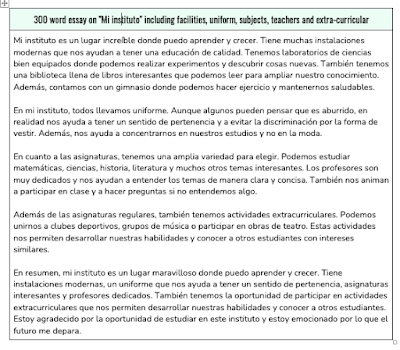
Here is one of the prompts I used: 300 word essay on "Mi instituto" including facilities, uniform, subjects, teachers and extra-curricular. Immediately a text was created. It is useful to note that you can edit the text which Diffit creates before clicking the button to get student activities. 


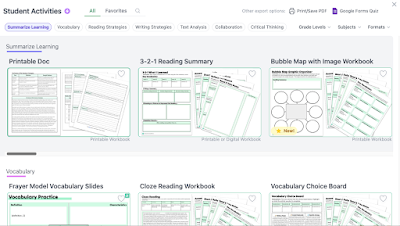
Once you are happy, click on 'Get Student Activities' and then select from the wide range of options available, as listed in the tabs across the screenshot below: 


Here are the activities created once I had selected my preferred option, with a variety of download options available: 


 I'm excited to check this out in more detail over the coming weeks and to share with colleagues. 


Sunday, 1 March 2015

#ililc5 The annual (and much-loved) ICT Links into Languages conference

Those who may have strayed onto this blog before will know that I go to Southampton every February for the ICT Links into Languages conference. And every year, I bubble over with enthusiasm for how amazing it all was, from the speakers to the delegates. And this year was no exception. I have made loads of notes which I will blog about here over the coming week.

For starters, here's the link to Joe Dale's excellent Keynote links on Flipboard 

http://flip.it/EsiHv

Saturday, 16 February 2013

#ILIC3, "When ideas are shared, the result is always greater than the sum of the parts" Rich Willis

Those who follow me on Twitter or have read previous posts on this blog will know that I am a huge fan of the annual ICT Links into Languages conference (ILILC) held in Southampton. And not without cause. This event is a superb form of CPD, no matter what your level of ICT proficiency or years of teaching experience. There are a wide variety of talks and workshops, offering delegates the opportunity to put new ideas into practice and ask for help if needed. Over the next week or so, I will blog about the workshops I attended as well as the two I delivered. There are also two keynote speeches as well as the now legendary Show and Tell on the Saturday night.
Joe Dale's keynote looked at ICT and the need to move on. He talked about the use of iPads in the classroom, referring to @elearninglaura as well as pointing us towards www2.hull.ac.uk/ifl/ipadresearchinschools.aspx with research into the use of iPads in education. Pupils learn best when there is a perfect balance between "have to", "need to" and "want to" Joe also pointed out how information overload is affecting our learning and that it is important to have time off. There are 10 million active Twitter users in UK - as educators, we must consider the importance of how we move education on in light of this. Should we ban or embrace mobile technology? There is an issue of kids with no home Internet, even with lunchtime access and we must remember this. At this moment in time, there is a lot of stress on teachers, lack of professional consultation although Joe did point out that Gove is pro MFL.
Joe tied his talk together by mentioning crowdsourcing to get ideas and feedback, such as #mflstar by @bellaale It is important to "harvest"your own CPD and go for authenticity in the classroom. We have to stick together, ask for help, share ideas.
Of course as the affable "Godfather" of the MFL Twitterati, Joe Dale knows better than most the value of sharing ideas and inspiration. The ILILC conference once again proved that the MFL Twitterati are as close in real life as on Twitter, that as teachers we have so much to offer each other in terms of ideas and support, and that a little bit of love and shared enthusiasm can take you a long way. People are already talking about #ililc4..

Thursday, 8 March 2012

#ILILC2 APPY LEARNING by LISA STEVENS

It was brilliant to see Lisa after her fairly recent departure to Switzerland, although it must be said that we were too busy playing with the iPads to make many notes! Lisa gave us a quick tour of the iPad and offered just a selection of the many uses that language learners can make of it with guidance from the teacher. We had a chance to play with the iPads as well as check the Posterous blog Joe Dale is creating, http://ipad366.posterous.com/ There is more information on Lisa' website http://lisibo.com as well as documents to download.

Sunday, 4 March 2012

#ILILC2 KEYNOTE Joe Dale "Turn on, tune in, Dropbox out"

Joe Dale kicked off proceedings on the Saturday morning with a great keynote which belied his poor health of the week leading up to the ICT Links into Languages conference. Joe Dale set up the Twitter list of MFL teachers affectionately known as the MFL Twitterati which has gone from strength to strength, and Joe addressed the power of collaboration in this keynote.
Joe talked about the shift in governmental thinking, round to technology in education including a call by Michael Gove for a Wiki curriculum in the Guardian to better enable a collaborative approach as well as his call at the BETT Show 2012 for teachers to be trained to best use the technology available.
Joe talked about the #pencilchat Twitter phenomenon which had us laughing out loud as well as nodding our heads in agreement to the Twitter thread which had focused on attitudes to technology:

He then talked about our pupils as 'prosumers', producing as well as consuming social media and being saturated by it. Social media is the #1 pastime for teenagers and we need to use that in our teaching.
As a facet of this, the fabulous Deputy Mitchell was encouraging all to blog on 29th February. Deputy Mitchell's Twitter blurb reads "Quadblogging/ Feb29th.net founder, keynote speaker on mission to get kids everywhere blogging to a GLOBAL audience" His aim is to get pupils to think about the power of an audience,something which is a no brainer for linguists who are constantly aiming to show pupils the relevance of our subjects. The idea behind quadblogging for those who are unfamiliar with the concept is that four schools from around the globe get together and blog about a like-minded theme. Joe talked about further ways to show pupils the relevance of languages such as his experiences on the European Day of Languages,at the Ashcombe School, where he did a live 1 hour broadcast.
Moving on, he then talked about his current blog ipad366.posterous.com where Joe produces a 2-3 minute podcast giving a tip a day about using iPads.
Mentioning the site education.skype.com Joe encouraged all language teachers to find a class to share educational goals with you. This tied in nicely with Suzi Bewell's TES article Modern foreign languages – Skype makes sense
Alex Bellars got a shoutout with the excellent tools that he had talked about at the Show and Tell in Newcastle namely Class Dojo, Triptico, and Lingro And finally in this section, with another article SecEd ICT in MFL Suzi Bewell talks about using Vocaroo as a way of spicing up language learning outside the classroom by doing a speaking homework. Joe tied all of the practical examples into his talk by saying this is what Ofsted is looking for according to their guidelines.
The final section of Joe's talk was called 'Dropbox out!' The aforementioned #MFL Twitterati is now at maximum capacity with 500 on the list. All conference attendees were invited to ‘join the conversation’ All would agree that support is the biggest and most important aspect of Twitter for the #mfltwitterati.We have set up a generic Dropbox for Modern Languages, as well as separate ones for French, German and Spanish. Get in touch with any of the MFL Twitterati if you are interested in joining.
Other areas of support include aPLaNet which is European funded,and which has a huge number of resources to help ML teachers with resources, mentoring and to help those who don’t normally use social media. Joe talked about the MFL Show and Tells that have taken place around the UK, as well as digital sharing of support and ideas via paper.li/mfltimes which you can receive free by email, full of the best tweets, links and ideas each day. MFL Digital Stories got a mention as well as the wonderful MFL Storybirds
The final mention went to QR codes in education. Ideas for include sticking the QR code into the pupils' exercise books once kids have had their work marked as well as
Kelda Richards' amazing work with QR codes and Aurasma. See Kelda's blogpost Le Mur Parlant The note I typed when Joe mentioned this was "DO THIS!!"
Joe drew his keynote to a close saying that one in three is overwhelmed by technology whilst promting the study of languages with Barack Obama's quote "If you have a foreign language that is a powerful tool to get a job… you are so much more employable, you can be part of international business" Joe had tweeted in the weeks leading up to #ILILC2, asking us to tweet our pupils' favourite method of learning, using the hashtag #groovymfl. Ironically, most responses favoured a more low tech approach. The lesson we must learn as language teachers and tech lovers is that a blended approach works best, rather than throwing the baby out with the bathwater.

Wednesday, 29 February 2012

#ILILC2


So my second visit to Southampton for the ICT Links in Languages was much anticipated and did not fail to impress. There was much excitement amongst the attending members of the #MFLTwitterati on Twitter in the weeks leading up to the conference, both from those of us lucky enough to have attended last year, and those who were coming for the first time.
There was a gathering of the clans on the Friday night, with the unveiling of the wonder that is Suzi Bewell's #mfltwitterati t-shirts.

This set the tone for the whole weekend. The workshops and talks were excellent, led by Joe Dale and José Picardo's fab keynotes, and the chance to network, meet new enthusaistic language teachers and chat was superb. I am going to blog about the brilliant workshops and talks I attended over the next week or so, but suffice to say there was plenty of expertise, stimulation and humour on show.
The highlight for many was the Show and Tell on the Saturday night, with just the right level in terms of weightiness of topics combined with singing, dancing and general euphoria. It is enough to mention human dominoes, Tchik et Tchak, turnips and barmen to provoke sniggers and laughs from all who were there.
In these days of pressure and stress, #ILILC2 was a much needed tonic and a wonderful opportunity to catch up with many of my PLN whom I now consider true friends.

Thursday, 1 October 2009

FLASHMEETING #3 AND ITS CONSEQUENCES

Well, we had our third MFL flashmeeting last Monday and whilst I participated less, with a blinder of a headache, it was still a stimulating and enjoyable experience, as well as being extremely benficial for my teaching.

Flashmeetings serve to remind me how much I have come to rely on the support of my online friends whom I have met through Twitter primarily, as well as at Joe Dale's IOW conference. They are a constant source of support and inspiration, and this flashmeeting was no exception.

The two areas I have decided to focus on, arising out of the meeting, are Spanish phonics and Edmodo. I still have a lot of work to do in terms of phonics and pronunciation, but José Picardo has inspired me to set up an account on Edmodo (www.edmodo.com) I have created course areas for each of my classes and have already posted some polls in Spanish and set some assignments.

When I was showing the setup page to the pupils, many commented on its similarity to Facebook, and the trendy look of the site. Several have already posted comments and queries on their course area.

I look forward to using Edmodo and will post soon on the progress we are making.

Wednesday, 24 June 2009

Guest posting and my year of web 2.0

I was genuinely flattered to be asked by Ken Royal to be a guest author for his blog http://www.educatorsroyaltreatment.com, although I asked him what he felt I had to offer as I really feel like a complete novice at this whole malarkey! It is true that I have a great enthusiasm for all that I use in my classroom, but I would never profess to be any kind of expert. I work on the theory that if I want to do something, it is surely possible, so it is just a matter of working out how So I settled down to it, and here is my post for Ken's site.

LANGUAGES AND LEARNING - THE PATH I HAVE FOLLOWED
Today I led a whole-day event on ICT & MFL teaching and learning, which included my own department as well as 12 members of staff from several other schools. I have never led such an event before and therefore wanted to keep the numbers manageable.
Why did I even want to run such an event? Believe me, I was asking myself the same question last night, as I prepared the last of the handouts. But yet I am so glad that I did, for it has benefited me as well hopefully as those who attended. As teachers, we are told that we should be reflective practitioners, and yet it is rare that we have time to take stock and really evaluate what we have learnt over a given period of time. The aim of running this day was to show people some of the new stuff I have learnt over the past year, and let them have a go too. It was only when I started to map out the agenda that I realised just how much I have learnt since last July, when I had the extreme good fortune to be sent to BLC 08, in Boston. The November Learning conference was mind-blowing and I came home enthused, armed with a list of of sites to visit and web 2.0 tools to check out.
I followed the instructions of David Truss (http://pairadimes.davidtruss.com) and Ewan McIntosh (http://edu.blogs.com/) who both said that if we did nothing else, we should start a blog when we went home. This I did, with my "Languages and Learning" blog at http://amandasalt.blogspot.com I also joined Twitter, although I found it a lonely and pointless activity initially. I now find it to be one of my main sources of CPD (Continuing Professional Development) and also a place where people are generous with their praise and genuine in their concern.
A visit to the Isle of Wight for a languages and ICT conference, organised by the amazing Joe Dale (www.joedale.typepad.com), added to my enthusiasm, and as I approach the end of this academic year, I have created a wiki for my pupils (http://spanishingrosvenor.wikispaces.com) and also dabbled with Audacity, Goanimate, Voki, ToonDoo, Animoto and Voice Thread, amongst others.Today I ran workshops on all of these as well as an overview of blogging, Twitter and Diigo.
The format seemed to work well, with a very hands-on approach by the participants, and a vast quantity of helpsheets to take home. They were amazed that I did none of this before last summer, ut in a way, I think that reassured them. I do not profess to be an expert at any of these, yet I find my approach to teaching re-energised and my pupils highly motivated. I too have much to learn, and it is a true pleasure to show others all that this brave 2.0 world has to offer us.