Showing posts with label languages. Show all posts
Showing posts with label languages. Show all posts
Thursday, 3 October 2024
TPL Thursdays! Language Landscape: Exploring New Pedagogical Approaches
Today it was an absolute honour to present alongside my past pupil and friend Jonny Nelson of Ballyclare High School, as part of the TPL Thursdays! Language Landscape series. Here is my presentation:

Monday, 1 February 2021
Languages and your career, by past pupils #ggsfamiliaespañola
Huge thanks to our brilliant past pupils who have make a quick clip talking about studying and working with Spanish and languages.
Friday, 1 April 2016
Everyone is a genius.... A little bit of differentiation

This year as a staff we are looking at differentiation, what we currently do and sharing good practice on staff days and in departmental meetings. I personally would say that I struggle with the challenges of differentiation in the traditional terms of multiple worksheets to choose from, etc. However I am enjoying the different ideas we are coming up with and seeing how pupils respond to them.
A fairly recent arrival to the Spanish Department is our Challenge Grid. I first spotted a tweet by Jake Hunton https://twitter.com/jakehuntonMFL and Jake kindly emailed me his template to use and adapt. The basic premise is that pupils should see how many points they can accumulate in 15 mins. This is one for our Form 1 pupils on the topic of physical description (obviously when it is displayed as a powerpoint, there won't be underlining)

Another option is to give them a worksheet with sentences with different points values and tell them they need to score a certain number of points, as demonstrated here by my colleague's worksheet.

A third idea we are trialling around choices is an Extension PPT. My colleague has made this first one and I have then made another for the Form 3 topic of clothes.

Another staff focus this year is marking for improvement. And surely there is no greater differentiation than tailoring the learning to suit the individual pupil. As part of this, I am looking at feedback inc highlighting the correct work in A level essays rather than showing what's wrong and witholding their score until they have had DIRT time. The pupils have really liked the positive highlighted marking and they are now learning to apply the mark scheme better as they look at what they have done well and write their own www and ebi

I am building DIRT time into lessons at all levels, including using our purple pens for self-reflection. It is enlightening and rewarding, for the pupils and for me.
Another marking and feedback idea I am excited to try out is LIFT, one of many ideas I have magpied from the great Gianfranco Conti https://gianfrancoconti.wordpress.com/2016/02/21/six-things-i-tried-out-this-year-which-really-enhanced-my-teaching/
"LIFT, or Learner Initiated Feedback Technique .... consists of questions about linguistic items they are using in their written pieces that they annotate in the margin of the page they are writing on. For example, if they are not sure whether a clause requires the subjunctive or conditional mood, they will underline or circle the verb and write on margin: “Is this verb supposed to be in the subjunctive? Why/Why not? This year, I have used it more consistently, extensively and, more importantly I have insisted on higher quality questions. It has made me enjoy giving feedback more and my students have reported benefitting from it"
Further reading I've really enjoyed on marking and differentiation can be found at https://gianfrancoconti.wordpress.com/2015/05/12/five-things-you-should-do-when-you-correct-your-students-essays/ as well as http://justtryingtobebetter.net/marking-is-feedback-is-differentiation-is-planning/
As well as these newer ideas, there are strategies that I have been using for months or years that are also individualising the learning and hopefully therefore differentiating. By creating iBooks at A level and some at GCSE, I am allowing pupils to work at own speed and choose their activities. The drawback from the pupil perspective is that some pupils may not be good at timing and pacing themselves and I have found that some don't cope so well and need more of a guiding hand to stay on task. The same has happened with setting their own HWs at A level. It has been excellent for many pupils but I need a better system for checking what pupils have done and some don't want to choose their own homeworks or don't do it and try to get away with it. At the moment they have a choice of a Learning Log or a simple tick grid.
We also have Challenge Corner with Challenge Cards, Jenga with accompanying Spanish sheets, Spanish novels, translations of books like Diary of a Wimpy Kid and Harry Potter, magazines and comic books. This year I've also brought in the idea of Cushion Corner, so that pupils who finish first aren't 'penalised' by being given another worksheet but can choose what they would like to do from any of the above to extend their learning.
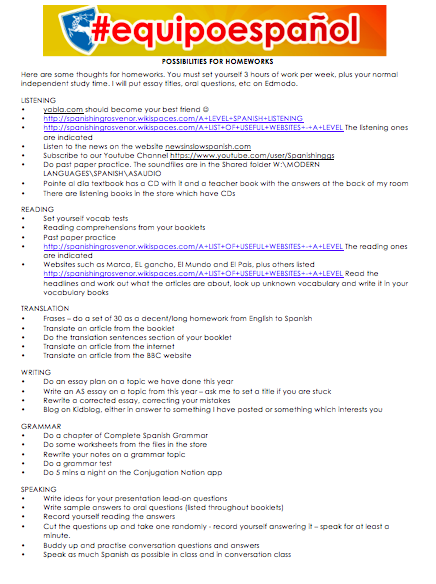
An idea that is bandied about a lot now on Twitter is Takeaway Homework or giving pupils a choice when it comes to CATs and that's something that we would like to look at as a department. For me the difficulty is balancing the choice for the pupils (which I love) with the need for CAT scores for report cards, so we'll need to look at that.
Finally if you haven't seen it, check out https://www.tes.com/teaching-resource/the-differentiation-deviser-6233159, 81 slides of differentiating ideas for the classroom.
Saturday, 7 March 2015
#ililc5 Lisa Steven's Keynote @lisibo Cooking on Gas
The #mfltwitterati legend that is Lisa Stevens who blogs at http://lisibo.com/ gave us a splendid Keynote to finish entitled "Cooking on gas" At times I put my iPad down and just listened and enjoyed so these are rough notes, apologies. Lisa has blogged about her session here http://lisibo.com/2015/03/cooking-on-gas-ililc5/
Cooking on gas has different meanings; giddy, really making progress and all is going well. As Lisa said, we are all teaching different languages, we have different ways of teaching and we teach at different schools. Lisa tweeted re the essential ingredients for a language lesson and here are the replies:


Cooking on gas has different meanings; giddy, really making progress and all is going well. As Lisa said, we are all teaching different languages, we have different ways of teaching and we teach at different schools. Lisa tweeted re the essential ingredients for a language lesson and here are the replies:
What proportions will you use of the above ingredients in your lessons?
Are the games the flour or the chocolate chips? What are the essential ingredients?
Each group is different so therefore you use a different recipe.
Do you always get the same result from following the recipe?
We might all do some stuff from this weekend at #ililc5 and not have the same result.
Cupcakes are a treat, a reward. Our ultimate purpose is to feed and nurture. Is all praise and no correction not going to spoil them if we feed them only cupcakes and no proper food? Is primary language teaching seen like this by some secondary teachers?
Lisa says that pupils need a balanced diet of "yes you're doing well but here's what you're doing wrong"
She made reference to the Great British Bakeoff where Richard was often the star baker who made the best showstoppers, but he didn't win. Teachers can pull an excellent lesson out on the day for the inspector but their day to day basis can sometimes be poor teaching. Lisa compared teaching to bread - do some kneading, then leave it alone for a bit, the finished product takes a while to get there.
She then made reference to the infamous scenes from the GBBO with Ian, where there were accusations of sabotage. In the same way, we can feel that losing pupils to music lessons, SATs, sports fixtures etc, you can be left feeling that they are out to get you. And we also feel like throwing it all away. Sometimes things go pear-shaped and we are tempted to never use it again. Don't give up. Sometimes we focus on the wrong thing (ice-cream melts) and actually there are bits that were very good in the lesson.
Lisa then moved on to Celebrity chefs - what makes them a celebrity chef? Opportunity. Being in the right place at the right time. There are plenty of excellent chefs who aren't famous. We are no less teachers because we aren't talking at the conference and vice versa.
There are kids who need our attention, it doesn't matter if positive or negative.
Who is your language hero? Your A level teacher? Lisa's teacher's pencil case used to come flying across room and it was your turn if it landed on you. She was eccentric but her lessons had great content, She wasn't there to pass an exam, but to make the pupils love Spain and Spanish-speaking countries. She used cultural titbits to keep the pupils engaged. She made kids feel valued and that they could do Spanish.
There are things pupils are good at and not good at. Pupils need very basic instructions and to know where to look for them.
Are languages les fruits moches of the curriculum? Are our pupils seen as that? The kids who find it difficult, who struggle, often benefit most from languages. They often interact more in language, they want to contribute. Yet they are always taken out for extra help. Give him a break, he's enjoying Spanish. Do deals with them, get there. The only reason some pupils behave like that is because they are too bright for that group.
Cooking well doesn't mean cooking fancy. It's good if it looks nice but it's not essential, that's not what we're interested in.
Lisa talked about Herman the German friendship cake - people sharing, up to you to take away, make your decision which bit of recipe to use, what flavour etc
A balanced diet is vital, use tech etc, just judge which tools to use at the right moment.
Remember that following the recipe doesn't always mean success and you don't have to be famous to be good.
This was a brilliant Keynote to finish off what was a fabulous and inspiring weekend. To quote Heather from TeachMeet Belfast "We are the people we have been waiting for"
#ililc5 Ryan Hoy @Taisez marking

The above quote is from @marymyatt, an inspector who tweets and blogs. Ryan asked in his session "How do we mark?" We did a sample marking exercise showing that we use different systems, eg using highlighters, using a code eg circle and W for word
Pupils have hugely different experiences of marking and they can struggle with this.

Ryan developed the following system which is now used throughout the school:
Pink for bad and green for really good, code. Leave out stuff that's correct but not really good


Exp - express it better, explain it more. As Ryan explained, the planning stage is the most important stage. Give success criteria for the question so that pupils know how they can score well.


In a slight twist on this, I gave U6 their timed essays that they wrote earlier in the week back to them and they went through highlighting their fabby phrases (idiomatic language, connectors, subjunctive, etc) in green and any errors they now spotted in pink. Those who wanted to then swapped with a peer to repeat the process of proof-reading. It will interesting to see what they have picked out when I mark it.
I think more than anything, the point that resonated with me was on the slide 'no ego-building comments, green is more than enough' I am going to trial this approach and I'll let you know how it goes.
#ililc5 Ryan Hoy @Taisez Investigative learning
It was lovely to hear a fellow Norn Irishman at ILILC and Ryan delivered a very impressive session on investigative learning. He did his examples using History rather than focus on one language.


John Connor @bootleian got a shoutout here with his belief (and mine) that we need to move from being the sage on the stage to the guide on the side. ie we need to move away from giving the pupils everything. The temptation is to give them the answers but that doesn't move them on as effectively in their learning. Ryan also pointed that authentic collaboration is where pupils are working together on a task that genuinely needs more than one pupil to work it out, rather than a group of pupils doing a task that could easily be done by one pupil.
So what do good investigations have?
Intrigue
Confusion
Intense challenge
Team work/collaboration
A shared outcome
Red herrings
Clues


TENETS
- Confusion to a) heighten challenge b) induce engagement. Engagement not fun, two different things. Gave them all time activities at the start of the lesson and worked backwards
- Extreme challenge (throwing students into the "Learning Pit") throw them in and let them climb out at the end - James Nottingham
- Group-based investigation
- Independence (silent beginning, cryptic instructions) eg our starter activity here
- A roving, "prompting" teacher - to help them along with
Ryan ended the session by showing us a 14 minute video which had been recorded over an hour's lesson with him and a class of above average pupils. The key points were:
- There were paper signs for start of lesson - Hola and Sentaos por favor, rather than him speaking.
- First activity on board - unscrambling. The pupils started to talk to each other. Activity 1 was blue tacked under the desk - the groups had to organise words into sentences. The group discussions were very insightful.
- Activity 2 A sentence on the board said "Comparatives always bracket a noun - ¿estás de acuerdo?" (Do you agree?) There were Spanish phrases stuck up round the room. There was an icon of Eyes on the screen as a clue along with a series of comparatives in English to translate.
- Activity 3 was a series of sentences which started with half Spanish and half English and worked towards full sentences in English to translate into Spanish.
- Activity 4 was to rank the drugs from least addictive to most addictive.
- Finally there was a Plenary on whiteboard
This was an excellent lesson and an impressive session overall. The pupils were working at a high level with very little input from their teacher and even those who struggled were engaged with the tasks. I enjoyed this session and look forward incorporating ideas into my lessons.
Wednesday, 4 March 2015
#ililc5 Eleanor Abrahams @elvisrunner Challenge and Differentiation
I started to blog about this fab session by the ever-enthusiastic and gifted @Elvisrunner aka Eleanor Abrahams and then realised that my soft-focus photos were no match for her blogpost http://elvisrunner.blogspot.co.uk/2015/03/now-theres-challenge-ililc5.html
Opening with a great quote and a dramatic chair-falling off incident by @lancslassrach, this session was crammed with good ideas for challenge, focusing on 6 key areas.


 Eleanor recommended reading "Advancing Differentiation" by Richard M Cash.
She then got us to do the following activity.
1) We had to draw an eye
2) She gave us a set of 5 eyes drawn by hand and told us to select the one that was closest to ours
3) She then asked us did we think we could copy the next-best drawn eye. We set to, with the sample to guide us and the option of a "How to.." photocopied page.
4) Eleanor then asked us did we think our drawing had improved.
This was a way of pointing out how our pupils feel and how we could encourage them better in the tasks we set them. If you put the perfect version on the board at the start, a lot will say "well I can't do that" If you get them to do theirs first then show them how to improve, it empowers them.


 Ask them "Which colour best represents your sentence?"


Opening with a great quote and a dramatic chair-falling off incident by @lancslassrach, this session was crammed with good ideas for challenge, focusing on 6 key areas.
Eleanor talked about one of my favourite current topics on Twitter, Growth Mindset.
How do you get their buy-in? How do they say they can do it and believe that?
She gave us some tips for having that conversation with the pupils.
She then got us to do the following activity.
1) We had to draw an eye
2) She gave us a set of 5 eyes drawn by hand and told us to select the one that was closest to ours
3) She then asked us did we think we could copy the next-best drawn eye. We set to, with the sample to guide us and the option of a "How to.." photocopied page.
4) Eleanor then asked us did we think our drawing had improved.
This was a way of pointing out how our pupils feel and how we could encourage them better in the tasks we set them. If you put the perfect version on the board at the start, a lot will say "well I can't do that" If you get them to do theirs first then show them how to improve, it empowers them.
Put this map up on the board and ask them to write sentences for the weather forecast.
Now give them another go, showing pupils step by step how to improve their work is less upsetting for them. Tapping into Growth Mindset, it's about making them believe they can do it.
Here Eleanor talked about turning traditional differentiation on its head and providing more of a challenge from the start.
I used this activity today with Form 2 and it was really successful. It can obviously be used at any level too which is always an advantage.
All in all, this was an excellent session and I left totally inspired with some wee ideas to put into place immediately as well as more long-term planning to incorporate into our Schemes of Work.
Tuesday, 3 March 2015
#ililc5 James Gardner @langnut Takeaway Homework
James Gardner says that electing to do Takeaway Homework (whereby pupils choose what they are going to do from a list of options) gave him and his department an opportunity to make something meaningful out of something which many schools struggle with. He found loads on @teachertoolkit's blog which was his initial inspiration. He also recommends reading Mark Creasy's Unhomework book. What is the purpose of the homework we set? Why do so many pupils not do it? What can we do to make it purposeful for pupils?
They started with Homework grids but they were hard to make up for staff and there wasn't much benefit for the pupils re more doing it, etc
For all the sessions, there were a lot of good ideas from the audience, and this was no exception. Prim aka @chapeluser said that she asks for evidence of WHAT they have done to learn the vocabulary set as homework. Jonathan aka @trekkiep mentioned that his school has a 5 period day with period 6 for kids who don't submit HW during the day. Their parents are texted to let them know and whilst there are some who avoid it due to buses etc, there has been a reduction in the number of pupils who don't do their homework.
In James' school, there are set Prep sessions with subjects allocated specific slots. Whilst there are advantages to this, the drawback would be that ICT homeworks are more limited as a year group of students cannot get onto PCs all at the same time.

Prim suggested adapting the above menu to have a points score, a little like Vocabulary Man which is often mentioned on the MFL Resources forum. The pupils could be set a tarif of 50 points so they could do 5 x 10 point tasks or one 50 pointer. This would allow for differentiation as well as more technically complicated tasks.
Sometimes pupils must do something specific eg vocabulary revision but generally all homeworks are a free choice from the menu.
James showed us some fantastic results eg two girls doing a video on personal details.
However he added that there is a danger that they choose something they haven't done in class and therefore they struggle with the target language or they just don't put the effort in. He has therefore added instructions on the takeaway homework menu not to do a task unless the topic has been covered in class or it is a research HW. He has also added tasks with more chillis for differentiation and to make it more challenging. Finally he has added vocabulary desserts. Taking feedback on board, pupils now have printouts for their books and it is also on his door in case they lose it.
James stated that there had been mixed feedback although generally good at year 7, but that year 8 more negative. Again, acting on feedback, he is going to add a tickbox. And one complaint from pupils was that they couldn't ask their peers for help if they were all doing different tasks but actually this has proved to be a positive thing from the staff point of view.
Ways to move the takeaway homework on would be to have an online version with hyperlinks to Quizlet etc; to have tick box management or Idoceo to monitor / track tasks; to think about Google classroom.
James concluded that overall the quality of work on a weekly basis is higher and there has been whole department buy-in.
I do a form of Takeaway Homework with A level already but this session has made me think seriously about how to introduce it at KS3. The issues we face are the Common Assessment tasks that already form part of our Schemes of Work which would be non-negotiable homeworks as well as the fact that there is a varying level of access to tablets and PCs at home. However it is a concept that we will be introducing over the next year or so and it was great to hear James' experiences and see what to do or to avoid.
Sunday, 1 March 2015
#ililc5 The annual (and much-loved) ICT Links into Languages conference


For starters, here's the link to Joe Dale's excellent Keynote links on Flipboard
Friday, 26 September 2014
Here are some of my favourites:
A generic one. (3 depressing facts. Today isn't Friday. Tomorrow isn't Friday. Even the day after tomorrow isn't Friday)

Form 3 are doing parts of the body (I've got your nose)

Form 2 and Form 5 are doing the topic of education (When your teacher separates you from your best friend in class)

Yes, you could probably find most of these using a search engine but the excellent thing about Pinterest is its ability to store these pins for you.

Reflections of an iPad classroom 26/9/14
Oh blog, it's been a while. Apologies but I'm sure I'm just like the rest of you, hitting the ground running after the summer.
So the iPads are still with me for the foreseeable future and the HODs and SMT in school have all got one each too. It's been weird for me trying to think about how to use one iPad in a classroom when I'm used to at least one between two, one each at A level. There are certain apps which lend themselves to it of course, from the fabulous Explain Everything to my two of my favourites for starters, Decide Now and Make Dice Lite.
I have been using Explain Everything in three main ways. Firstly, I have made some videos, using old PPTs and recording audio with them, as a way to flip the classroom. The videos are uploaded to Edmodo and the pupils can access them there in advance of the lesson, which frees up the lesson time to consolidate learning. Secondly, I have marked pupil work which they uploaded to Edmodo, talking through mistakes as I circled them using the pen tool and then I uploaded the video back onto Edmodo for them to watch and correct their work. Lastly, I have taken pictures of pupils' work in class as we have worked through translation work. It is easier for them to see corrections if they can see the base model on the screen and we talk through the different options they have too. I am finding that they are contributing more than they would otherwise.
With the set of 17 iPads, we have been using Quizlet in bursts within the lesson to consolidate vocabulary acquisition. The pupils love it and feel it has really helped them learn the vocab. I set up a departmental account that they all log in to, which means that the tailored vocabulary is there waiting for them. Interestingly, we find the website better than the app, if you choose to use it.
Finally, today I used Plickers for the first time. I had read about it on Twitter but hadn't done anything with it yet. It's a way of using one iPad in the classroom to assess pupil understanding and record answers. I'll do a separate blogpost on it soon.
Tuesday, 1 July 2014
Network for Languages Philip Campagna Differentiation
We were able to attend a series of talks/workshops run by Routes into Languages In our school last month. The first I went to was Differentiation by Philip Campagna. Here are my rough notes:
Of the ways to differentiate, the easiest (although a bit of a cop out) is differentiation by outcome.
Most teachers teach to the middle.
Be careful with extension work, a lot of bright children don't like the idea that they're given harder work, they want to go deeper.
If differential gets wider within a class, planning gets harder and harder.
Target the individual pupil, give them autonomy.
Is planning more about getting through topics or helping learners progress in their learning?
The attitude of the learner is key. How do we get a learner to buy in?
Look at language acquisition rather than rote learning with little comprehension.
Writing is just copying at this stage. We want them to develop skills.
David Crystal A little book of language.
We should be like tennis coaches, break it down, exaggerate it.
Differentiation by support, let them see the bigger picture, work the first two questions as examples.
Teacher, pupils helping each other, classroom assistant.
Language ambassadors/leaders. Get them to talk to younger pupils re what it was like to go through GCSEs.
Audit rest of staff to see if they have any languages.
Differentiation by text / resources.
Need to build in challenge even for lower ability pupils.
Differentiation by task. Eg do similar task where weaker ones interview 6th Years, as they find writing difficult.
Differentiation by interest: what are they interested in?
Do they want to go off skiing etc? Interview them re interests eg future plans and teach them that vocab
Teachers dislike identifying less able pupils but kids know.
Use 'at least' as this gives even weakest chance of success. (At least 2 better than at least 5)
Replace at least 5 words in the text with synonyms
Use same photo for different activities with different year groups.
Form 1 as self.
Forms 2-3 as third person.
A level conditional
Differentiation by support. Give less able pupils key words or ask them what words they would want to say.
Improvise as many sentences as you can which contain the word X (eg Tigre) Go table by table for feedback on possible sentences.
Writing
Differentiation by support:
Explain to your partner how you did something, figured something out.
We don't give them iPhone classes but they work it out because they want to.
Ask kids how we could use the technology.
Ability groups or mixed ability groups acc to fitness for purpose.
Try boy/girl seating plan for some activities. Watch the boy dynamics.
Work in groups to reconstruct the text.
Network for Languages Philip Campagna Group Talk
The second session at the Network for Languages event was led by Philip Campagna on Group Talk. Brain child of Greg Horton, we have been playing around with the idea of Group Talk for a while now so I was keen to hear what Philip had to say. Here are my notes:
Developing independent learners
Barriers to effective speaking:
How do I monitor it? As opposed to other skills where I collect the answers in.
Nature of the tasks - often mundane, transactional and predictable. Non-engaging stimuli.
Often confined to pair work, lack of collaborative group work.
Poor pronunciation due to lack of coverage of basic phonics.
Talking cards round the room, pupils went round, pressed the button and answered the question. Made them think on their feet. This is something I could do with the iPads.
Phonics
a e i o u Do a point and repeat exercise
Do a chopping sign for acute / accent
Give them mini flashcards with the sounds oi, ui etc and one person in group holds up the sound card as the teacher calls the sound.
Phonic trains - join in as lead pupil in each train moves round class making the noise of their card.
Sheets with image groups eg trois, poisson, oiseau etc.
Restricted meaningful use of TL impacts negatively. Make it meaningful and purposeful.
Peer pressure, not cool to speak out in class
3 names on slide, ¿cuántos años tienen?
Opinions, speculative language . Give them this language.
Rules of engagement
Stage 1
Groups of 5, first turns card over, says something and turns it back over. Next person does the same. No comment from others in group.
Stage 2
Give opinion (positive or negative)
Stage 3
Add adjectives, or justifying statements,
Stage 4
Others respond to the statement with agreement or disagreement
Turn photos face up. First person says something. Only one person at a time, if two speak at once then one backs off. Tell them to have three responses to their comment in the group then move on to next photo.
Give me one phrase from each table that you would have liked to have had
Do the Group Talk sheet as a levelled framework
Develop speaking activities which move away from role play activities
Talk to the pupils about what they want to study eg past tense?
Step away and don't comment when they are talking.
MAKE A GROUP TALK DISPLAY BOARD
Note to self: Bring photos back in at start of lesson as a starter, use the Guardian Eye Witness app
Subscribe to:
Posts (Atom)