Wednesday, 22 July 2026
AI in education at this stage

Wednesday, 6 November 2024
Reading Progress in Teams
Yesterday my Year 9 Spanish class submitted their Reading Progress assignment on Teams, whereby they read their winter oral exam aloud and Teams gave colour-coded feedback on the accuracy of their pronunciation. I was able to go into each response and listen to their recording whilst following on the screen and edit Teams’ feedback very quickly and easily, clicking on words which I disagreed with. It was quick and easy to do, and let me see common recurring issues as well as who needs more or less support. I think that Year 9 will find it useful as they come to do the actual oral exam in a fortnight, as this should reduce the number of marks they lose for pronunciation.

Thursday, 3 October 2024
TPL Thursdays! Language Landscape: Exploring New Pedagogical Approaches
Thursday, 28 March 2024
Using AI to create resources and exploring Diffit
I have been dabbling with AI for a while, mainly as a means of creating resources and also to model introductions and conclusions for pupils in their literature essays.
I started with Chat GPT and have learnt that the more precise you are with your prompts, the better the output. This includes the key stage and word count. Here are some of the prompts I have used, as well as the outcomes:
• Make a worksheet about descriptions in Spanish
- Create a worksheet where pupils practise physical descriptions in Spanish
• Write 200 words about extreme sports in Spanish
- Create a blankfill activity of this text, leaving 10 blanks

• Write an introduction of a maximum of 100 words for the Spanish film El Bola on the topic of Pablo

• Write an introduction of a maximum of 100 words in Spanish on the character of Bernarda in La Casa de Bernarda Alba
Bernarda, la protagonista de "La Casa de Bernarda Alba", es una mujer autoritaria y de carácter fuerte que ejerce un control absoluto sobre su familia y su entorno. La obra de teatro, escrita por Federico García Lorca, se desarrolla en un ambiente opresivo y claustrofóbico en el que Bernarda impone sus normas y su visión del mundo sin importarle las necesidades y deseos de los demás. A lo largo de la obra, la figura de Bernarda se va revelando como un símbolo de la represión y la intolerancia que caracterizaban a la sociedad española de principios del siglo XX.
• Create a text for GCSE Spanish about the environment

- Create a reading comprehension in English on the above text, 10 questions and provide answers

As an MIEE 2023-24, I learned about Copilot in one of our monthly online meetups and have started to use it. For example, I used the prompt "Write a 100 word introduction in Spanish for an essay on the topic of Represión y simbolismo en La Casa de Bernarda Alba"
La Casa de Bernarda Alba, una obra maestra de Federico García Lorca, nos sumerge en un mundo de represión y simbolismo. Publicada en 1936, la historia gira en torno a Bernarda Alba y sus hijas, confinadas en su hogar tras la muerte del padre. El luto impuesto por la madre las ahoga, convirtiendo la casa en una prisión. El simbolismo es constante: el color negro, el bastón de Bernarda y el caballo cargan significados profundos. En esta atmósfera opresiva, las hijas anhelan libertad y luchan por vivir según sus deseos. Destacando entre ellas, Adela, la más rebelde y luchadora, personifica esa ansia de liberación.
This will serve as a starting point with my A level pupils to discuss what makes this a good or a weak introduction as we approach exam season and are looking at how to best improve their essays.
This week, I read Joe Dale's post on LinkedIn with interest about Kathryn Greene's Wakelet collection on Diffit. I signed up for an account and as a teacher, I automatically get a 60 day premium trial. You can immediately start to create resources, setting your parameters including grade and language.

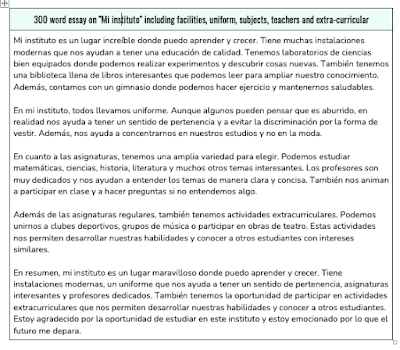
Here is one of the prompts I used: 300 word essay on "Mi instituto" including facilities, uniform, subjects, teachers and extra-curricular. Immediately a text was created. It is useful to note that you can edit the text which Diffit creates before clicking the button to get student activities.

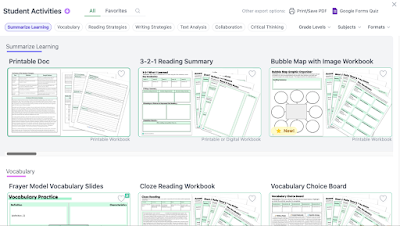
Here are the activities created once I had selected my preferred option, with a variety of download options available:



Wednesday, 1 February 2023
Welcome to the world of teaching literature
Today I had the great privilege of talking to the Modern Language PGCE students from Queen's University, Belfast. The first talk was about using technology for assessment, marking and feedback (see previous post)
The second talk was one of my personal favourites in teaching, teaching literature to A level Spanish students
Friday, 26 March 2021
Tuesday, 9 March 2021
Flippity quiz show on GCSE Spanish Daily Routine and A level ser and estar

Friday, 5 March 2021
If you can't pay it back, pay it forward
As those of us in the know, know, so to speak, there is really no better community of educators than the Modern Language teachers, known collectively as the #mfltwitterati amongst others. The sharing of ideas and resources is unbelievable and inspiring.
Today I asked for help applying the theories of Gianfranco Conti re the correct order of activities and almost immediately I had access to resources from @SrSpall, @BotonesSalgado, @Aurelie_LTH and @MrsWardMFL
I took our existing PPTs, then took inspiration from Aurelie's templates for more Spanish activities on the topic of clothes and combined them into one mega-PowerPoint. You can download it from Slideshare here
I want to add that my brilliant colleague Julie in the Spanish dept isn't on Twitter but constantly makes resources for our dept, some slides of which are in here.
Tuesday, 23 February 2021
Tuesday, 16 February 2021
Deck.Toys delight
Within a day of starting to use Deck.Toys I had already decided that the potential was so great that it was worth investing in the Pro account. So far I have made KS3 sets on shopping, house and clothes, a GCSE set for daily routine and an A level set for subjunctive phrases.

Esmeralda Salgado has made a really useful Youtube video about creating your decks. You can choose different templates, from linear to a boardgame.


We have all the vocab for KS3 and GCSE on our Quizlet so I was easily able to export the vocab sets to Deck Toys to use as the study set within each deck. I also exported them to Blooket, Gimkit and Flippity as well as quickly creating activities on Wordwall and and Learning Apps. I was then able to embed those activities into my Deck as well as using the plethora of activities available within the deck.

It's easy to assign a deck to a classroom or share with other teachers. I'm also sharing the decks I make via a Wakelet collection
Sunday, 14 February 2021
Checking out Deck Toys
I have heard a lot about Deck Toys recently so decided to check it out, using @botonessalgado's very useful video on how to create a new deck I have all the vocab for the units we teach in Quizlet which means that it is very easy to import it into Deck Toys and set up a new deck. Here's a very basic one I have made for KS3 Spanish on shops and quantities. Now that I've got the basic concept, I'm off to make some with my sentence builders
Wednesday, 10 February 2021
Assessment and feedback in Microsoft Teams
Thursday, 4 February 2021
Monday, 1 February 2021
Pay it forward: pets las mascotas
The wonderful MFL teachers on Twitter and Facebook have been sharing ideas and resources generously as usual, via those media as well as in webinars such as the fab one presented by @mflswavesey hosted by Joe Dale and Helen Myers for ALL, Elena Díaz for Linguascope and the TM MFL Icons webinar with Esmeralda Salgado, Elena Díaz, Adam Lamb Thais López Martín and Kate Jones with the MFL Icons team Coordinator Bex Noble and the team @rosannahume and @missMFL16
So I thought that I would share some of the links for games I have made. I am asalt518 on Blooket and Gimkit if you search for me, you should be able to copy sets.
Here's some for pets (las mascotas):
Flippity Flashcards with Spanish and English audio
2nd tab list 3rd tab practice
Click on more for the following options listed below or click on these hyperlinks:
Bingo
Crossword
Send Side 1 terms to Crossword
Send Side 2 terms to Crossword
Manipulatives
Send Side 1 terms to Manipulatives
Send Side 2 terms to Manipulatives
Send both sides to Manipulatives
Matching Game
Send terms to Flippity Matching Game
Quiz Show
Send terms to Flippity Quiz Show
Randomizer Wheel
Send Side 1 terms to Randomizer
Send Side 2 terms to Randomizer
Scavenger Hunt
Send Side 1 terms to Scavenger Hunt
Send Side 2 terms to Scavenger Hunt
Snowman
Word Cloud
Send Side 1 terms to Word Cloud
Send Side 2 terms to Word Cloud
Word Search
Send Side 1 terms to Word Search
Send Side 2 terms to Word Search
Word Scramble
Send Side 1 terms to Word Scramble
Send Side 2 terms to Word Scramble
Languages and your career, by past pupils #ggsfamiliaespañola
Huge thanks to our brilliant past pupils who have make a quick clip talking about studying and working with Spanish and languages.
Friday, 20 November 2020
No prep retrieval practice ideas
In the mild chaos and serious exhaustion of hotdesking, it's been great to have a few tricks up my sleeve this year while the computer logs on or to finish the lesson. Here are three activities which my classes are loving:
- 4 Squared An oldy but goodie which I had never used before this term. Draw 4 squares on the board then ask a question. Whoever gets it right gets his/ her name on the board: once you have 4 names, the next pupil to answer correctly chooses someone to eliminate from one of the squares. I give stickers to the 4 in the box when the game ends.
- Stand up if You say or display a phrase in MT or TL and they stand up if they think they know it. You choose one of the pupils standing and if they get it right, everyone standing up gets a point. If they get it wrong, everyone standing loses a point. I gave a sticker for reaching 4 points and a sticker for every point after that (5 stickers = a positive on lesson monitor) It works brilliantly at all levels.Yes, some might not stand up at all but they still seemed to enjoy it
- Vindictive You can do this orally or with a mini whiteboard each. All pupils stand up to play. Call out a word, the first person to call out their name and answer immediately when called upon or to write the correct trans choses someone else to sit down. If they are sitting down, they still play and if they win the round, they stand back up & knock two others out. The winner is the “last man standing” If two pupils are left at the end but someone sitting down gets the correct answer first, they stand back up and knock the two standing out and ultimately are the champion. No prep and excellent retrieval practice as well as for learning new vocab if able to look at list as play
- The wonderful @Chapeluser shared this with me last year and which I'm going to try it out again this week
Site smashing with vocab lists
- Create your word or sentence list, tabbing from the target language to the English.
Copy it all and paste it into a new course on Quizlet. Pupils enjoy Quizlet for the flashcards and games as well as playing Quizlet Live in individual or team mode.

- Go to Memrise and sign in. Select the Courses tab, create a course, fill in the details and set it up. When the empty vocab list appears, click on advanced and select bulk add words then paste your vocabulary list. My pupils like the fact that they can gain points for each vocab set they learn.


- Go to Gimkit and select New kit then select Create with flashcards and paste the vocabulary list. This is always a favourite either in team mode or individual.

- Go to Blooket and create a new set, pasting the same vocabulary into the set. The games on Blooket include the classic game which is like Kahoot, the race and the Battle Royal game. The graphics are cool and the pupils love choosing their animal icon.


- Go to Carousel Learning and download the template to create the question bank. Paste the vocabulary and complete the final column for the topic/s. Upload the question bank spreadsheet and then create a quiz using this question bank and allocate it to a class. This is new to us this week and the pupils have found it really useful to test their learning and retrieval of vocabulary. @Carousel_Learn posted this on Twitter:
